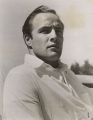
Marlon Brando
 | |
|---|---|
| Full name | Marlon Brando Jr. |
| Date of birth | April 3, 1924 |
| Place of birth | Omaha, Nebraska, USA |
| Nationality | United States |
| Occupation | Theater and film actor, director, public figure |
| Professional career periods | 1944—2004 |
| Family (Relationships) | Several marriages, children (11 children, 3 with a housekeeper) |
| Friendship | James Dean, Martin Sheen |
| Awards | 2 Oscars, BAFTA, Golden Globe |
| IMDb ID | 0000008 |
| Wikiserial ID | 0000007 |
| Variants of genuine autographs
(click to enlarge) |
|
Marlon Brando was an American stage and film actor, director, and public figure who had a fundamental influence on the development of acting in the second half of the 20th century. His name is associated with the dissemination of a psychological method of acting based on the inner experience of a role, a rejection of theatrical conventions, and a desire for maximum emotional authenticity in on-screen performances.
Brando is considered one of the key figures in the history of world cinema. His work became a benchmark for an entire generation of actors, and the characters he created are still considered benchmarks for dramatic performance.
Biography
Marlon Brando was born on April 3, 1924, in Omaha, Nebraska. His father, Marlon Brando Sr., worked in business and was known for his tough personality. His mother, Dorothy Pennebaker Brando, possessed acting talent and performed in amateur theater productions in her youth, but suffered from alcohol addiction. The unstable family atmosphere had a significant impact on the future actor's development.
Brando's childhood was marked by frequent moves and emotional tension. He early demonstrated independence, a tendency toward rebellion, and a dislike of authority. His school years were marked by conflicts with teachers, disciplinary actions, and expulsions. Formal education held no value for him, but he possessed keen observation skills and a keen sense of human psychology.
Early Steps in Film
Marlon Brando's path to professional acting began with the theater. In the mid-1940s, he moved to New York City and enrolled in the Actors Studio, where he studied with Stella Adler and Lee Strasberg. It was here that he was introduced to the principles of psychological acting, based on the internal experience of a role.
Brando's first film appearances occurred in the late 1940s and early 1950s, in adaptations of stage productions. His film debut was met with wary reactions from studios, as his acting style differed sharply from the Hollywood standards of the time.
First Steps as a Public Figure
Brando's early success was accompanied by a rapid rise in public attention. He became the subject of media interest, but he was extremely negative about publicity. He gave interviews reluctantly, avoided social events, and often clashed with journalists.
Even at this stage, his image as an independent and unruly actor, unwilling to bow to industry expectations, had already taken shape. This reputation followed him throughout his career.
Early Film Roles and the Formation of an Actor's Personality
A key moment in his early career was his role as Stanley Kowalski in A Streetcar Named Desire. Brando's screen persona revolutionized acting. He showcased a new type of film hero—aggressive, vulnerable, and internally conflicted.
In subsequent years, he solidified this approach in The Wild One and On the Waterfront. For his role as Terry Mallow in On the Waterfront, Brando won an Oscar, finally cementing his status as the leading actor of his generation.
Formation of an Actor's Personality
Marlon Brando's acting personality evolved in constant conflict with traditional notions of the profession. He rejected outward ostentation, exaggerated diction, and pre-arranged gestures, considering them artificial. His method was based on internalizing the role, improvising, and allowing spontaneous reactions, which often caused tension on set.
Brando often deliberately violated script directions, changing the intonation and rhythm of scenes, focusing on the character's inner state. This approach was revolutionary for Hollywood in the 1950s and had a colossal influence on the development of acting. His acting style was perceived as a challenge to the established system, yet it determined the direction of dramatic cinema for decades to come.
He did not view acting as a craft subordinated to industry, but rather as a form of personal expression and psychological exploration. This approach made him both a cult figure and a source of constant conflict with producers.
Worldwide Fame and Key Films
Brando achieved international fame in the early 1950s, when his work began to be actively discussed not only in professional circles but also in popular culture. His screen characters embodied internal protest, alienation, and conflict with society, which resonated with audiences of the post-war generation.
Despite his success, Brando's relationship with Hollywood remained difficult. He openly criticized the studio system, refused promotional commitments, and was unwilling to maintain his image as a movie star. In the 1960s, this led to a decline in offers and a temporary decline in his career, exacerbated by the commercial failures of several major projects.
Brando's return to the pinnacle of cinema occurred in the early 1970s. His role as Don Vito Corleone in The Godfather became one of the most iconic in cinema history. The actor created a character that combined external restraint, inner strength, and tragedy, transforming the character into a cultural archetype.
"The Godfather" (1972)
The film's production was plagued by numerous disputes between Brando and the filmmakers. Nevertheless, his participation proved decisive in the project's success. He won an Oscar for the role, which he publicly declined in protest against discrimination against Native Americans in the American film industry.
This act sparked widespread public outcry and cemented Brando's reputation as an actor willing to sacrifice personal accolades for a principled stand.
Production and Environmental Activism
Marlon Brando did not view production as his primary source of self-fulfillment, but he did participate in a number of projects in which he sought to maintain artistic independence. He also devoted significant attention to ecology and environmental protection, long before these topics became widely discussed in the public sphere.
Production Projects
Brando's production activities were sporadic and selective. He participated in projects that aligned with his artistic and ethical principles, avoiding mass commercial productions.
Environmental Activism
Environmental issues occupied a special place in Brando's life. He acquired the island of Tetiaroa in French Polynesia, where he sought to create a model for the sustainable coexistence of man and nature. His interest in ecology was practical and long-term, rather than merely declarative.
Charitable Work
Brando provided financial and public support to various human rights and charitable initiatives, including organizations advocating for the rights of indigenous peoples and socially vulnerable groups.
Results of the Stage
This period of worldwide fame cemented Marlon Brando's status not just as an actor, but as a cultural phenomenon. His influence extended far beyond the silver screen, touching on social, political, and ethical issues.
Personal Life and Interests
Marlon Brando's personal life was complex and controversial. He was married several times and had numerous children. His family relationships were marked by dramatic events that seriously impacted his psychological state and attitude toward publicity.
In his mature years, Brando increasingly sought solitude, preferring a private life away from Hollywood.
Friendships and Social Connections
Brando maintained friendships with a number of famous actors and directors, but he was not inclined to socialize widely. His connections were deep and selective.
Hobbies and Interests
His interests included literature, philosophy, languages, and anthropology. He was interested in the cultures of various peoples and actively studied their traditions.
Diet and Lifestyle
At different periods in his life, Brando adopted different approaches to diet and lifestyle. In adulthood, he faced health problems, which affected his physical condition and professional activity.
The Impact of Personal Interests on Career
Brando's personal beliefs directly influenced his professional decisions. He turned down roles that conflicted with his views, even if they promised significant commercial success.
Travel and Exploration
Travel played an important role in Brando's life. He lived outside the United States for extended periods, exploring the cultures and lifestyles of different countries, which enriched his worldview and was reflected in his work.
Recognition, Awards, and Interesting Facts
Marlon Brando's reputation as one of the greatest actors in film history began long before his career ended. His contribution was measured not only by the number of awards he received, but also by the profound impact he had on the very nature of acting. Brando changed the perception of what a screen hero could be, shifting the emphasis from external expressiveness to inner psychological truth.
In professional circles, he was perceived as a controversial but exceptionally significant figure. Even during periods when he rarely appeared on screen, his name continued to be a reference point for actors, directors, and film scholars.
Awards and Nominations
Marlon Brando won two Academy Awards:
- Oscar for Best Actor – On the Waterfront (1954)
- Oscar for Best Actor – The Godfather (1972, award declined)
He was also repeatedly nominated for BAFTA, Golden Globe, and other international awards. His achievements were recognized with honorary awards for his contribution to the development of world cinema.
Inclusion in Ratings and Lists
Brando was regularly included in lists of the greatest actors of all time compiled by professional publications and film institutes. The American Film Institute has repeatedly recognized his roles as among the most significant in American history.
His characters became part of the cultural code of the 20th century, and individual scenes have become the subject of analysis in academic courses on acting and screenwriting.
Interesting Facts
- Brando was fluent in several languages and was interested in linguistics.
- He actively used improvisation, sometimes without informing his co-stars of his intentions.
- His refusal of an Oscar in 1973 was an unprecedented event in cinematic history.
- In his later years, he rarely gave interviews and avoided public appearances.
Public Recognition
Since Marlon Brando's death in 2004, his cultural impact has been further appreciated. Publications, retrospectives, and documentaries have confirmed his status as a figure who has had a lasting influence on film and theater.
Filmography
| Year | Title | Role |
|---|---|---|
| 1950 | Men | Kenny |
| 1951 | A Streetcar Named Desire | Stanley Kowalski |
| 1953 | The Wild One | Johnny Strabler |
| 1954 | On the Waterfront | Terry Mallow |
| 1962 | Mutiny on the Bounty | Fletcher Christian |
| 1972 | The Godfather | Don Vito Corleone |
| 1972 | Last Tango in Paris | Paul |
| 1979 | Apocalypse Now | Colonel Kurtz |
| 1990 | The Rookie | Leroy Corman |
| 2001 | Safecracker | Max |
Feature Films
| Year | Film |
|---|---|
| 1951 | A Streetcar Named Desire |
| 1954 | On the Waterfront |
| 1962 | Mutiny on the Bounty |
| 1972 | The Godfather |
| 1979 | Apocalypse Now |
Television Projects
| Year | Project |
|---|---|
| 1950s | Television and Theatre Productions |
Documentary Projects
| Year | Title |
|---|---|
| 1990s | Documentaries about Cinema (Archival Materials) |
Production Projects (Feature Films)
| Year | Film |
|---|---|
| 1961 | One-Eyed Jacks |
Short Films and Voiceovers
| Year | Project |
|---|---|
| 1990s | Behind-the-scenes work in documentary projects |
Photo Gallery
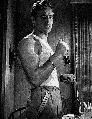
Photos of Marlon Brando from different periods of his life: his theatre years, the heyday of his Hollywood career, and his later years.
-

A portrait of Marlon Brando from Wikiserial -

-

-

-

-

-
-

-